 LearnSynth
Home
LearnSynth
Home
Value-oriented Consulting Pre-Sales, delivered inside your own team.
Two days of work on your real projects and a follow-up session after 30 days. This page describes the workshop itself: hour by hour, tool by tool. Terms, pricing and the four steps to book are on the page for companies.
- Group
- 6–8 people from one organisation, working in breakout teams
- Time
- 2 days × 8 h 9:00–17:00, on a date we agree together
- Balance
- 30 / 70 theory / practice on your own situations
- After
- 30-day follow-up online session with the same group
Nine blocks, each ending in a completed document.
The schedule is fixed; the examples are not. The main case study is prepared in advance so nobody has to practise on their hardest client straight away; the two or three situations you name in the brief enter the exercises in the second half of each day.
30% theory · 70% practiceUnderstand the client
People, goals, value flow, the discovery conversation.
- Opening — why we are hereNaming the problem and the goals of the workshop
- The method in brief: working around valueHow to think about value and the flow of work at the client
- Break
- Block 1 · Stakeholder and value stream mapping→ map of people + value map from the case
- Lunch
- Block 2 · Goal Identification per Position→ position / goal / strategy table + engagement plan
- Block 3 · The discovery conversation→ diagnostic questions, meeting plan, simulated conversation
- Break
- Block 4 · Usage situations→ completed scenarios for how the solution gets used
- Team presentations + conclusions of the day
Secure the project
Warning signs, documentation, handover, the selling approach.
- Recap of day 1Key conclusions, questions, agreements
- Block 5 · Warning signs and qualification→ red flag list: bad message early is a good message
- Break
- Block 6 · Control Letter and handover→ completed document from agreement to delivery
- Lunch
- Block 7 · Proposal Prompter + 10-point readiness→ a structured recommendation before the proposal
- Block 8 · Three phases of the buying process→ searching for a solution, validating, deciding
- Break
- Block 9 · Value exchange + success stories→ completed Success Story from your own project
- Final presentations + action list for Monday
What stays in the company after two days.
Every block produces one document. They leave completed, filled in on your own situations and ready to use on current projects.
Stakeholder Map (RPIAD)
A structured map of everyone in the deal, categorised as responsible, participating, impacting, approving, deciding. No blocker or critical voice gets missed, and the team can see who still needs to be spoken to.
Goal Identification per Position
A way to uncover the real business goals of each stakeholder in their role and context. Moves conversations from features to the outcomes that genuinely matter to someone.
Diagnostic Questions Bank
A curated set of questions that surface assumptions, constraints and warning signs early. It lets the team diagnose before it recommends.
Control Letter — from agreement to delivery
A short document recording the agreed scope, key assumptions, the sponsor, success conditions and known risks at the moment of signature. Nothing is lost when the project moves from sales to delivery.
Proposal Prompter + 10-point readiness
A tool for structuring recommendations around three questions: why this solution, why us, why now. Plus a checklist of ten points that must be closed before a proposal leaves the company.
Success Story Template
A template for writing up delivered projects — a sales tool and a reference at the same time. It turns delivered work into a company asset rather than just an invoice.
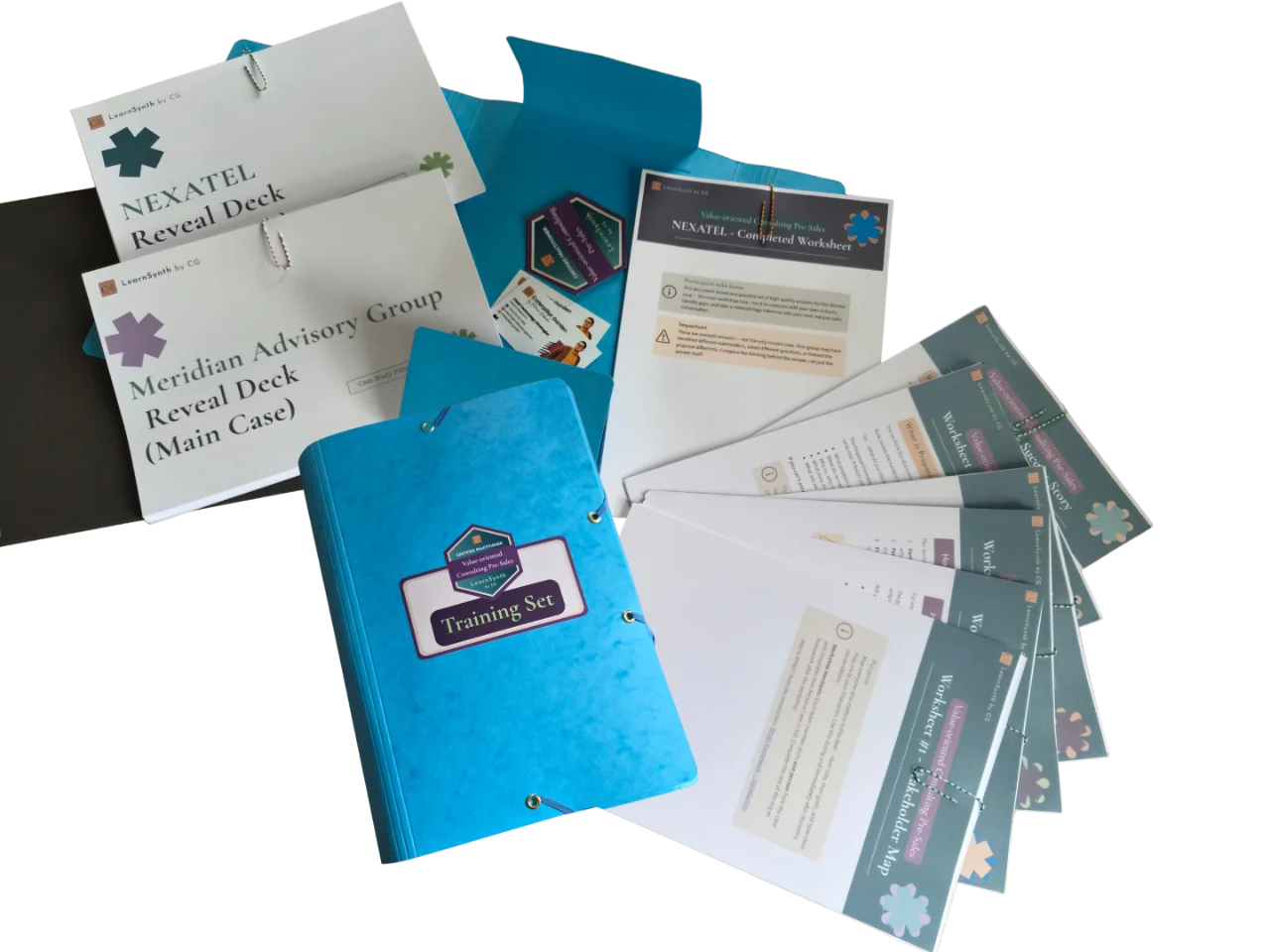
A folder of materials sent by post.
- Reveal deck for the main case study
- Second case — one per breakout team
- Worked example of the entire workshop
- 6 workbooks to fill in
- Certificate, digital and printed
- Badge as a sticker and a LinkedIn graphic
Three levels. The first shows within a week, the third after a few months.
This is also the list worth watching if you want to judge whether the workshop did anything.
What the team does differently
- No proposal gets written until the team can state the client's problem in one sentence the client has confirmed.
- They know who signs, who can block the project, and what each of them has at stake.
- They ask from a prepared question list before proposing a solution.
What changes in the organisation
- Projects move into delivery through one document both sides have read.
- Sales and delivery describe the same project the same way.
- Technical people run the conversations themselves instead of assisting.
What you stop losing
- Weeks poured into proposals that had no chance — recognised earlier.
- Rework after kickoff, because assumptions were written down before signature.
- Projects you have to walk out of — you leave in week two instead of week five.
The middle level depends on how much say the team has in how the company talks to clients. If they have none, two days will not change it — which is why the list below says when not to book us.
Five situations where it would waste your budget.
I would rather write this now than explain it after the workshop.
Proposals are decided by sales alone and the technical side has no say. People will learn things they will not be allowed to use.
You expect two days to fix the process. They will not, until someone changes what people are rewarded for.
The team has no access to the client or to the person who signs — and that cannot be changed.
You need a certificate for a tender, or a ready-made sales script. Neither exists here.
The group has less than two years in IT and has never had a scope conversation with a client. In a year there will be something to work with.
If you recognise your situation in the first three points, write before filling in the brief: contact@caterpillar.garden. A group smaller than six also makes sense — then sending people to an open cohort costs less.
The price covers the whole group.
Included: two days of facilitation, examples matched to your sector, six templates, a materials folder and certificate for every participant, and the follow-up session after 30 days. A group of 9–10: individual quote. A tailored programme: 25–40% above the base rate.
Full price table and the four steps to book →FAQ
How many people have to be in the group?
How does this differ from the open cohort?
On site or online?
Do we work on our own projects?
What language is it delivered in?
How is it invoiced?
Are the sessions recorded?
How much time does it take the team afterwards?
Who runs the workshop?
Start with the brief. Three minutes.
Six questions about the team, your sector and what you want to change. The quote and scope proposal come back within 48 working hours. If the workshop does not address your problem, I will write that instead of issuing an offer.